The SOC’s Integration Ceiling: Why Dynamic Workflows Are Non-Negotiable for Modern Investigations
Static integrations limit how far investigations can go; dynamic workflows remove that ceiling.

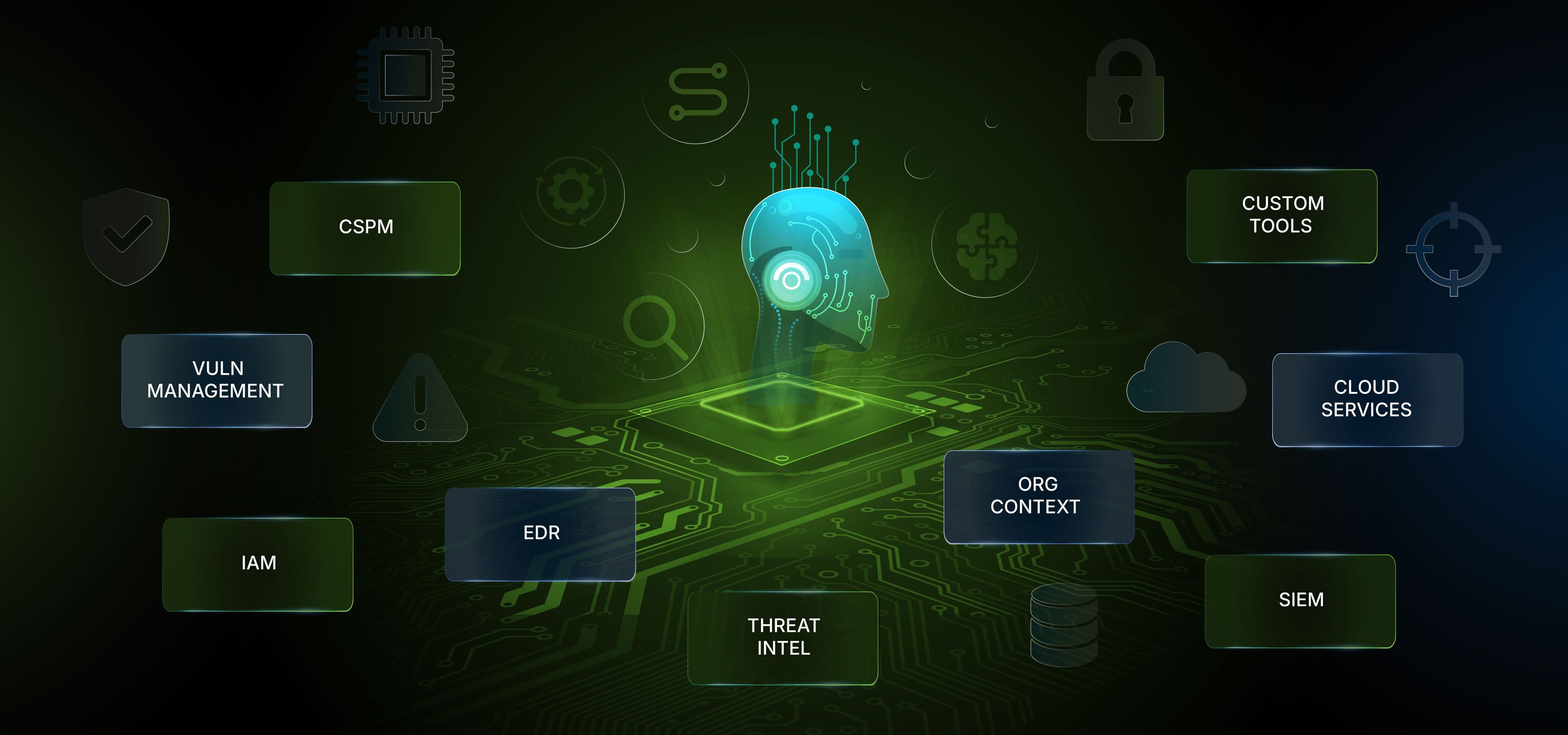
On paper, SOC tools are deeply integrated. In practice, those integrations rarely hold up once an investigation moves beyond the expected path.
Static playbooks struggle with scenarios that don’t follow predefined flows. Model Context Protocol (MCP) servers offer a fundamentally different approach, giving AI agents the ability to dynamically reach into any tool, at any stage of an investigation, without pre-scripted logic.
The Integration Problem No One Wants to Talk About
Every modern SOC runs on a patchwork of tools—SIEM, EDR, threat intelligence platforms, CSPM, identity providers, and ticketing systems.
The challenge isn’t access to these systems, it’s how investigations move across them. Most workflows are designed upfront, with a fixed sequence of steps that assumes how an incident will unfold.
Most SOC automation today is really just scripted sequencing. A SOAR playbook fires on a threshold, runs fixed enrichment steps, and routes the result to an analyst. If the investigation needs to pivot—from an endpoint indicator to a cloud identity anomaly to a third-party SaaS log—the playbook either doesn’t support it or requires weeks of engineering to extend.
Meanwhile, attackers don’t follow playbooks. The average breakout time for sophisticated intrusions has dropped to under 60 minutes. Your automation needs to be at least as adaptive as the threat it’s responding to.
Why SOC Investigations Are Inherently Dynamic
Consider a routine phishing alert—the kind SOCs handle every day. The playbook says: extract the sender, check reputation, scan attachments, enrich the URL, and close or escalate. Simple enough, until it isn’t.
What happens when:
- The URL redirects to a legitimate cloud service hosting a malicious payload? You need to query your CASB (Cloud Access Security Broker).
- The payload drops a script that modifies registry keys? You pivot to EDR telemetry.
- The script phones home to a C2 domain that only resolves for hosts on a specific subnet? You now need NetFlow data and DNS logs.
- The C2 infrastructure is shared with a known APT group? You pull threat intel enrichment from multiple feeds and check for lateral movement across identity logs.
No single playbook captures this chain.
Each investigation is a branching, context-dependent decision tree—the tools you need at step five depend entirely on what you found at step three.
This is the fundamental mismatch: rigid workflows for a problem that is anything but rigid.
Industry surveys consistently show SOC teams spend most of their time on manual, repetitive investigation steps, not because they lack tools, but because their tools don’t communicate fluidly enough. This gap has existed for years. What’s changed is that we now have a viable architectural pattern to close it.
Enter MCP: A Universal Connector for AI-Driven Investigation
The Model Context Protocol (MCP), an open standard created by Anthropic, introduces a different way to integrate security tools.
Instead of building point-to-point connectors between every pair of systems, MCP provides a shared interface, like a switchboard that lets any AI agent connect to any tool on demand.
An MCP server wraps an existing tool or data source—your SIEM, EDR, IAM platform, or threat intelligence feed, and exposes its capabilities in a structured way.
This means an AI agent doesn’t follow a fixed script. It decides what it needs, identifies the right tool, and calls it in whatever order the investigation requires. The workflow is constructed in real time, based on the evidence.
This is what makes MCP transformative for SOC operations: investigations no longer follow rigid paths, they adapt as they unfold.
What This Looks Like in Practice
Scenario: Compromised Identity with Lateral Movement
An alert flags anomalous privileged access on a production server at 2 AM from an account that typically operates during business hours.
A traditional SOAR playbook would enrich the alert with user context and perhaps check the endpoint, but if lateral movement detection isn’t built in, the investigation stalls until an analyst steps in.
With MCP-enabled agents, the investigation unfolds differently.
The agent validates the anomaly through the identity provider, moves to endpoint telemetry to check for process injection or credential misuse, examines network flow data for unusual internal connections, correlates findings with threat intelligence feeds, and inspects cloud audit logs if the account has cloud access.
Each step follows naturally from the last, nothing is pre-scripted, and no transition requires manual intervention.
Why Now: The MCP Ecosystem Has Reached Critical Mass
MCP isn’t theoretical anymore.
Since its launch in late 2024, the ecosystem has grown to over 1,000 publicly available MCP servers.
Google Cloud’s security operations platform now supports MCP for multi-vendor agent orchestration, Microsoft Sentinel has added MCP server extensibility for AI agents, and Cisco is building open-source frameworks for securing MCP-connected deployments.
For security leaders, this momentum matters. MCP servers for your existing tools likely already exist or are straightforward to build. You’re adopting an open standard with broad industry backing, not a proprietary framework that locks you into one vendor’s roadmap.
The question is shifting from “should we explore this?” to “how quickly can we operationalize it?”
The Strategic Shift for Security Leaders
For CISOs and security directors, MCP-based integration represents a shift in how you think about SOC architecture:
From “how many playbooks do we have” to “how many tools can our agents reach.” Coverage is no longer measured by pre-built automations, but by the breadth of your MCP-connected tool ecosystem. Every new MCP server expands the investigative surface your agents can operate across.
From “build vs. buy” to “connect and compose.” MCP is an open standard. If a tool has an API, it can have an MCP server—built internally, sourced from the community, or provided by the vendor. No vendor lock-in.
From “reduce alert volume” to “increase investigation depth.” The goal isn’t just to auto-close more alerts—it’s to investigate every alert with the depth that previously required your most senior analysts, but at machine speed, 24/7.
Where HarkX Fits In
This is the architecture HarkX is built around. Our AI agents don’t operate on static playbooks, they reason through investigations dynamically, connecting to your security stack through standardized integrations spanning EDR, SIEM, cloud platforms, identity providers, and threat intelligence feeds. The result is investigations that adapt to the evidence, not the other way around.
Organizations using HarkX are seeing investigation times drop by over 50% and MTTR reductions of 70%; not because we scripted faster playbooks, but because we removed the need for them.
About the author
Akshay is a Founding Member & Associate Vice President, GenAI Engineering at HarkX. With over nine years of experience building enterprise AI systems across cybersecurity, healthcare, pharmaceuticals, and CPG, he has led the development of large-scale AI platforms at Capgemini, BRIDGEi2i, and Sigmoid. His expertise spans agentic AI, LLMs, MLOps, and autonomous security operations.
Loved this insight?
Share it with your network and help secure the digital world.