Anatomy of MTTR: The Hidden Friction Slowing Security Investigations
Improving security operations starts with understanding where time is lost across the investigation lifecycle.


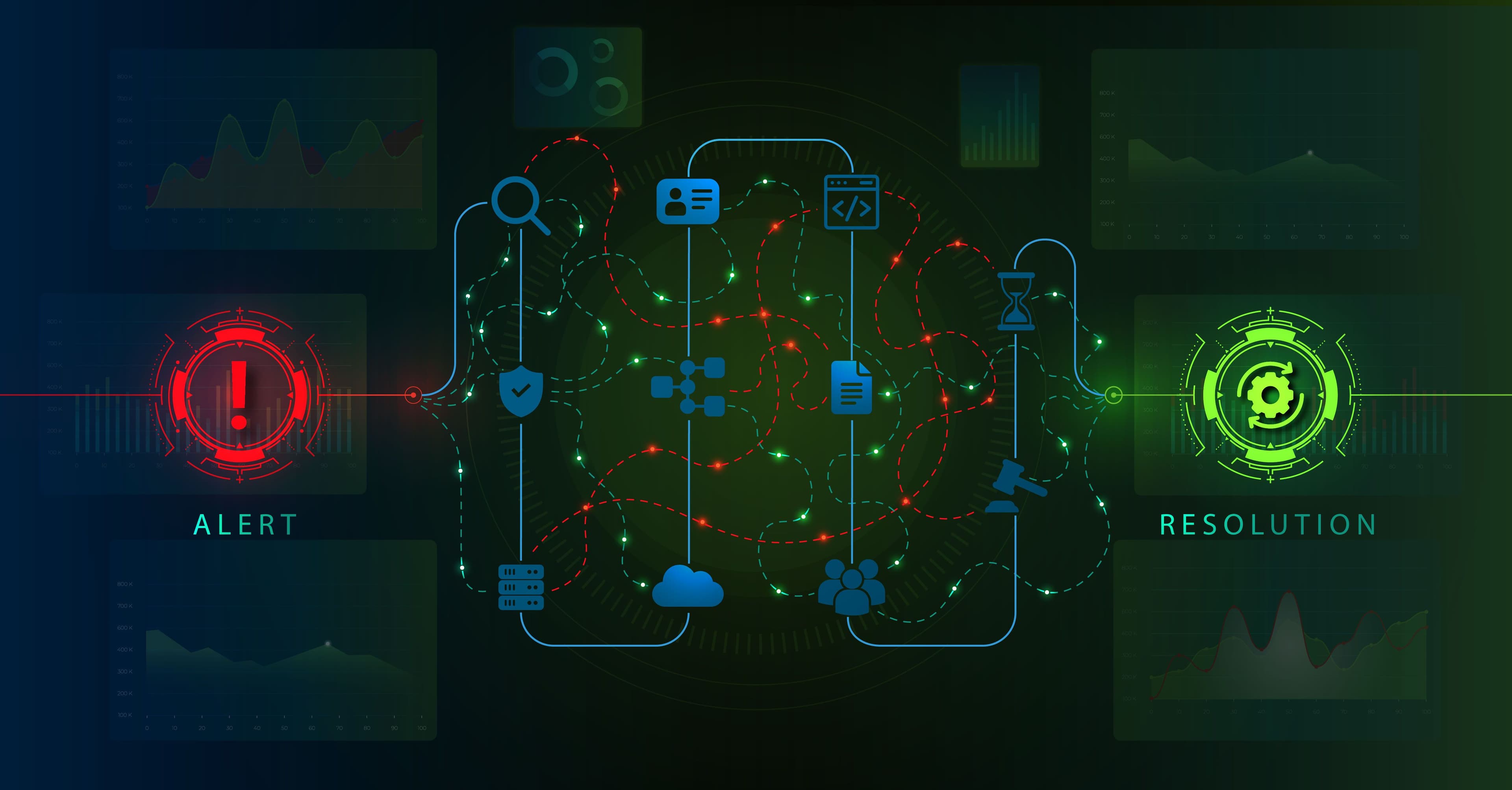
MTTR measures elapsed time between alert and resolution. What it does not show is how that time was consumed.
Was the delay caused by missing context? Manual investigation work? Analyst handoffs? Approval bottlenecks? Fragmented tooling?
That distinction matters because most SOC delays do not come from one dramatic failure. They come from small operational frictions that accumulate throughout the investigation lifecycle.
And those frictions are largely invisible inside a single average.
Detection Is the Beginning, Not the Bottleneck.
Security teams often talk about MTTR as if the problem begins at detection: detect faster, respond faster, resolve faster. But in many SOC environments, detection is no longer the main bottleneck.
An alert is only the starting point of an investigation. It tells you that something happened, not whether the signal is real, how broad the activity is, which systems are involved, or what action is safe to take next.
That work happens after detection, and that is where investigation time begins to accumulate.
The Friction Hidden Inside Every Investigation
In most investigations, delays rarely come from one dramatic failure. They emerge from a series of smaller operational inefficiencies across the investigation process.
Context Gathering: An alert is a pointer, not a full picture. Analysts still need to answer basic questions: who owns the asset, what identity is involved, what else happened before this event, and what other telemetry supports or contradicts it.
That information often lives across SIEM, EDR, identity systems, cloud telemetry, ticketing tools, and external intelligence feeds. Pulling that context together takes time, especially when analysts are manually pivoting across tools.
Triage with Incomplete Visibility: In most SOCs, triage optimizes for speed long before it optimizes for certainty.
When analysts have to prioritize alerts before full context is available, they make provisional decisions. Those decisions can create downstream rework: escalations that should not have happened, closures that need to be reopened, or cases that stall because the original classification was too shallow.
Correlation and Pivoting: Analysts pivot between tools to connect events: a suspicious process on one endpoint, a login anomaly from another location, a permission change in an identity system, or an API action in a cloud account.
Every pivot adds delay because the investigation process is distributed across multiple systems.
Deep Investigation: High-complexity incidents require scoping the blast radius, tracing activity over time, collecting artifacts, and determining the right containment path.
That effort scales with environment complexity. Ransomware, lateral movement, insider activity, and identity abuse are not just slower because they are “bigger.” They are slower because the investigation process itself is fundamentally different from low-complexity triage.
Handoffs and Rework: The moment another team gets involved — IT, cloud ops, identity, legal, or compliance — the investigation becomes a coordination problem.
Information has to be translated, validated, and often repeated. The receiving team wants evidence in its own format, from its own tools, and for its own decision-making process.
Approvals and Waiting: Some response actions require sign-off. Isolating a business-critical endpoint, disabling an executive account, or notifying external parties can involve approval chains that add hours or days. Missing telemetry, permission gaps, or slow exports create another kind of wait: dead time that appears inside MTTR but has nothing to do with analyst skill.
Why MTTR Can Be Correct and Still Unhelpful
This is the nuance that matters.
An MTTR number can be technically accurate and still tell you almost nothing useful about how the SOC is operating. Two teams can report the same MTTR and have completely different underlying realities. One may be moving quickly because it auto-closes a large number of low-value alerts. Another may be doing deeper investigations but losing time in manual correlation and approval bottlenecks. The number is the same. The operational story is not.
That is why MTTR is limited as a diagnostic. It tells you that delay happened. It does not tell you which phase created it, whether the delay was avoidable, or whether the final resolution was correct. For security operations, metrics should support diagnosis and improvement, not just dashboard reporting.
The Metrics That Reveal Operational Reality
The goal is not to replace MTTR. It is to make it interpretable.
That requires a core set of incident metrics that show where time is being lost. Applying P50 and P95 to those timings helps expose tail cases that averages hide1.
These metrics make the investigation lifecycle visible2:
- MTTD (Mean Time to Detect): how long it takes to identify an incident from the first activity.
- MTTA (Mean Time to Acknowledge): how long it takes to begin response after notification.
- MTTI (Mean Time to Investigate): how long it takes to investigate and understand the incident.
- MTTR (Mean Time to Resolve/Repair): how long it takes to restore service or complete resolution.
- False Positive Rate: how often alerts turn out to be benign.
- False Negative Rate: how often real threats are missed.
- Incident Count: how many incidents the SOC handles over a period of time.
These metrics align more closely with how modern SOCs operate, especially as teams move beyond simple detection-speed reporting toward investigation quality, workflow efficiency, and decision support.
The Real Meaning of a High MTTR
A high MTTR is not always a sign of slow responders. Often, it reflects fragmented context, manual investigation effort, and disconnected workflows.
MTTR shows the outcome. The anatomy of the investigation shows the cause. And that distinction matters more than most organizations realize.
Because the biggest delays in security operations rarely come from a lack of alerts or a lack of tooling. They come from the space between systems, teams, and decisions — where analysts lose time stitching context together, validating assumptions, and coordinating action across fragmented workflows.
That is the operational layer most dashboards never expose.
References
About the authors
Mahita Surapaneni is a marketing manager specializing in cybersecurity and emerging technologies. She leads content and thought leadership initiatives that help business and security leaders navigate topics such as Agentic AI, security operations, cyber resilience, and the future of autonomous security.
Srinivas Rao is an AI/ML leader, product strategist, and enterprise transformation architect with nearly two decades of experience building enterprise-scale AI platforms, including Aadhaar's Identity Fraud Management System serving 1.3 billion citizens and Samsung Bixby. An IIT Kharagpur alumnus, he leads HarkX's product innovation, advancing the shift from traditional automation to autonomous, agent-driven security operations.
Loved this insight?
Share it with your network and help secure the digital world.