Stop Hiring. Start Rebuilding: The Cybersecurity Talent Gap Is a Systems Problem, Not a People Problem
Everyone talks about the 4.8 million cybersecurity talent gap. Very few talk about why it actually exists.


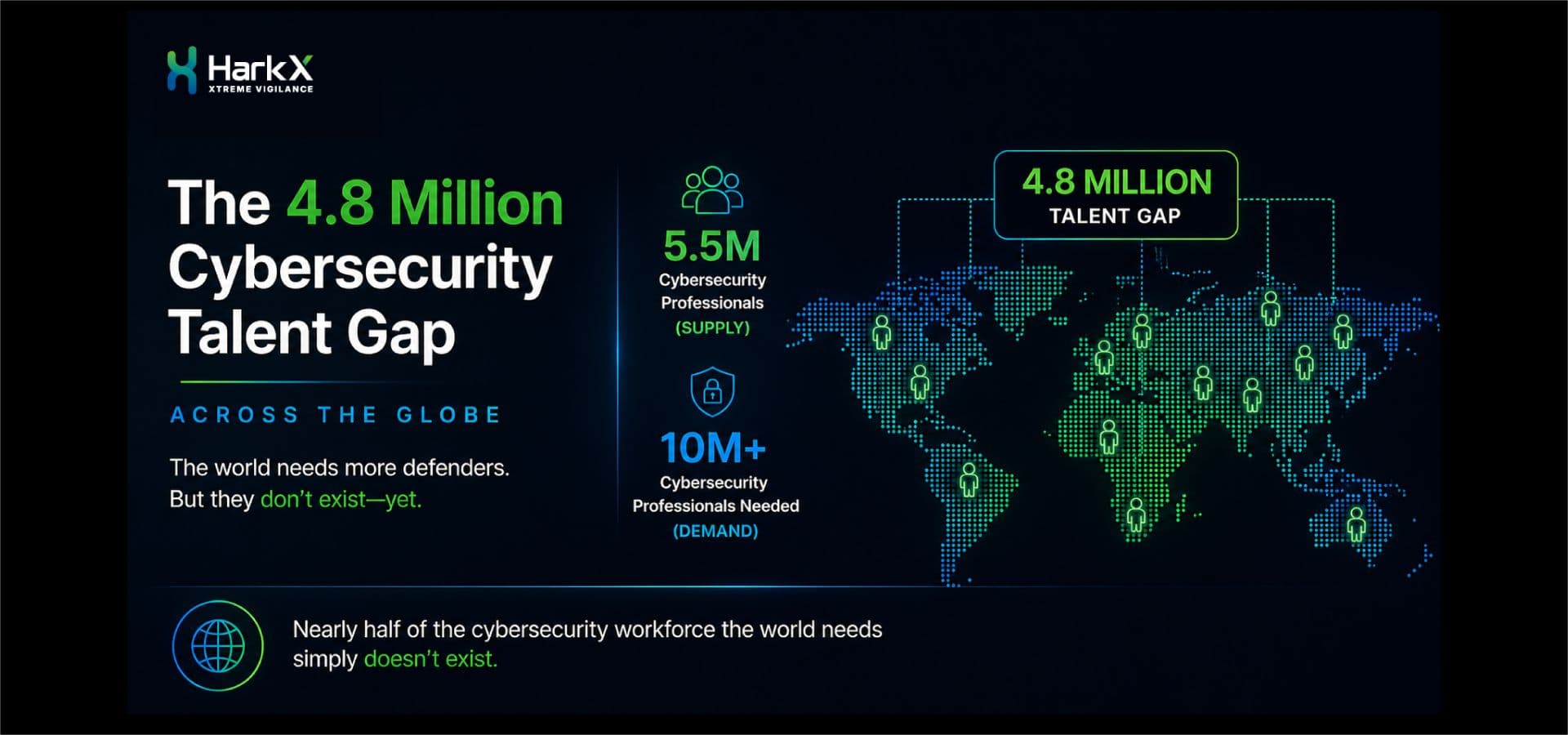
We’ve all heard the statistic: a roughly 4.8 million person talent gap in cybersecurity.
As security professionals, we feel this gap every time an alert goes uninvestigated, or a weekend is lost to manual correlation. But here is the hard truth we aren't discussing enough: This isn't a pipeline problem. It’s a structural one.
If we continue to address security as a "headcount game," we’ve already lost.
Here is why the math simply doesn't add up anymore:
The Reality Check
Today, there are roughly 5.5 millions[1] of cybersecurity professionals globally. To meet current enterprise demand, that number needs to be 10 million+.
Here are the reasons:
- Slow Growth: Workforce growth has stalled at ~0.1% YoY[2].
- The Widening Void: The gap grew ~19%[2] last year alone.
- The Impossible Ask: Closing it would require the industry to grow by ~87%[2] in a single leap just to break even.
Why "Hiring More People" Isn't the Answer
We are trapped in a system designed for a threat landscape that no longer exists. Even if we found the people, five barriers remain:
- Exponential Attack Surfaces: Cloud migration, AI adoption, IoT proliferation and other tech transformations have expanded the "front line" faster than the rate at which we can hire defenders.
- The Experience Paradox: 90% of hiring managers[3] demand "prior experience," effectively locking the door on the very talent we claim to need.
- The Complexity Tax: Fragmented tools and data silos have made security harder to operate, not easier. We aren't doing "security"—we're doing manual data entry across fifteen dashboards.
- The Human Ceiling: Demand is scaling exponentially whereas human capacity scales linearly. The issue is not just headcount. It is also capability. Many security teams are staffed on paper yet still lack the depth of skills needed in areas like cloud security, AI risk, detection engineering, and incident response.
- Wasteful Use of Human Intelligence: Too many security skilled professionals spend their time on low-value, repetitive alert triage and manual correlation, tasks that don't require deep expertise but consume most of their bandwidth. This isn't sustainable and prevents teams from focusing on high-impact work like hypothesis generation, advanced threat hunting, and innovating defenses in the agentic AI era.
A Shift in Perspective
While the headline 4.8M gap persists in many references, recent industry studies show the conversation has evolved to skills depth in areas like cloud, AI risk, and detection engineering is now seen as the binding constraint.
Maybe the real question isn’t “How do we close the talent gap?”
It’s: “Why are we still expecting humans alone to bridge an algorithmic-scale problem?”
The solution isn't just more resumes. It’s about rethinking how security systems handle context, correlation, and decision-making. When signals are connected into usable context, investigations are dynamically assembled instead of manually stitched together, and response happens within a system that already understands the environment, security teams can operate with far more leverage than headcount alone would suggest.
We need to move away from "tooling" and move toward "the architecture" where signals aren't just surfaced but are automatically stitched into a usable story.
This is exactly why we built HarkX. We aren't trying to give you another dashboard to monitor; we’re restructuring how SecOps works. By building a system that understands data context (org specific) and dynamic investigations natively, we allow the security professionals to focus on strategy, not manual labor.
We truly believe that security professionals need to dedicate their bandwidth in pushing the envelope on hypothesis generation, advanced threat hunting, and innovating security defenses in this agentic era.
The gap isn't going away. It's time we stop trying to fill it with people and start closing it with better architecture.
References
- https://10guards.com/en/blog/2024/10/18/cybersecurity-workforce-growth-stalls-and-skills-gaps-widen/
- https://programs.com/resources/cybersecurity-talent-shortage-stats/
- https://viva-it.com/insights/the-cybersecurity-talent-cliff-navigating-the-4-8-million-professional-gap-in-2026/
About the authors
Mahita Surapaneni is a marketing manager specializing in cybersecurity and emerging technologies. She leads content and thought leadership initiatives that help business and security leaders navigate topics such as Agentic AI, security operations, cyber resilience, and the future of autonomous security.
Srinivas Rao is an AI/ML leader, product strategist, and enterprise transformation architect with nearly two decades of experience building enterprise-scale AI platforms, including Aadhaar's Identity Fraud Management System serving 1.3 billion citizens and Samsung Bixby. An IIT Kharagpur alumnus, he leads HarkX's product innovation, advancing the shift from traditional automation to autonomous, agent-driven security operations.
Loved this insight?
Share it with your network and help secure the digital world.