10 Questions to Ask Your AI SOC Vendor Before You Sign
Ten questions that separate autonomous AI SOC platforms from rebranded chatbots, ask before you sign.

TL; DR
Every AI SOC demo looks polished. The real differences between platforms only emerge when you ask the right questions before signing the contract—not after responding to a security incident.
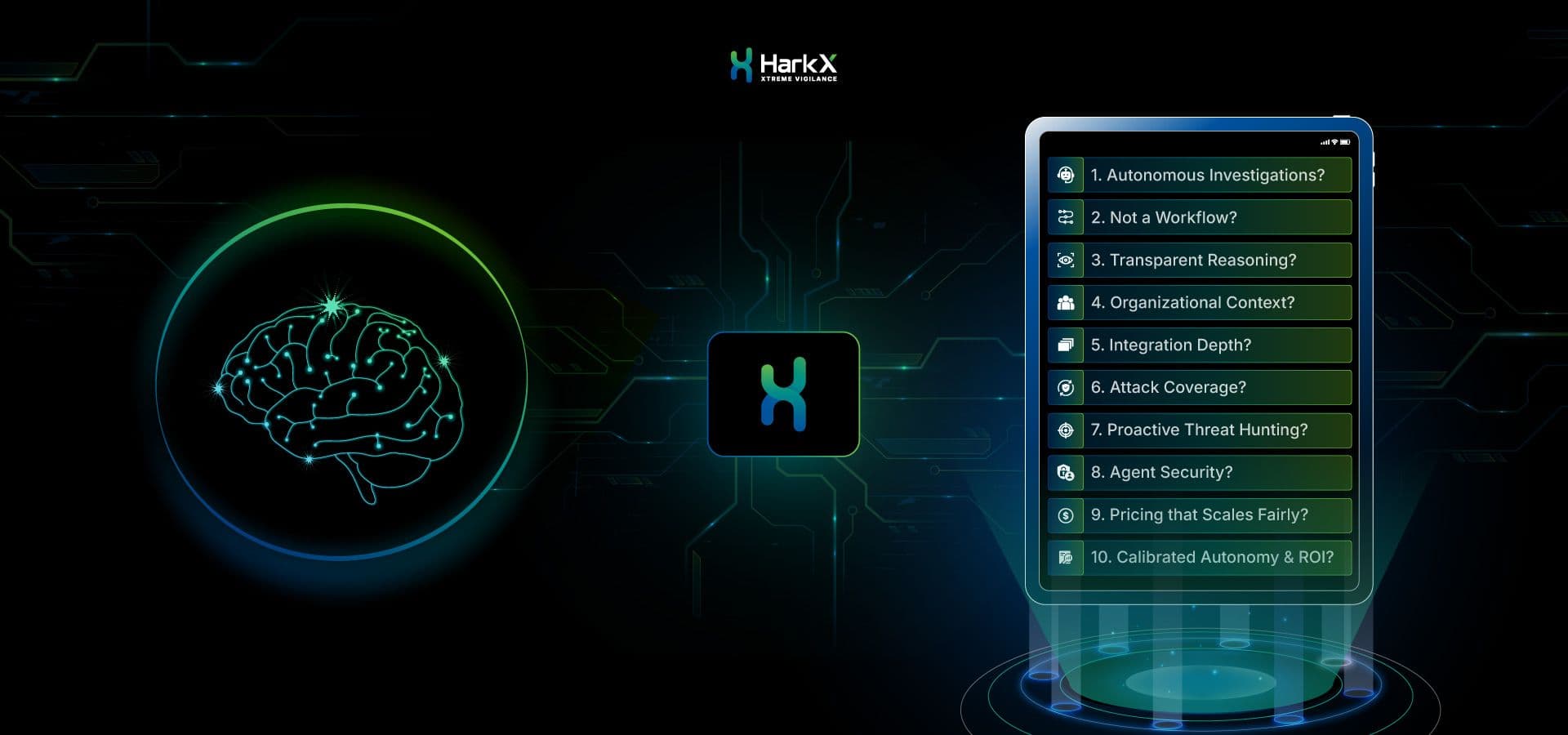
Use this checklist to evaluate vendors:
- Autonomy: Does the platform drive investigations end-to-end or wait for analyst prompts?
- Beyond Workflows: Can it reason through scenarios that were never scripted?
- Transparency: Does it explain its reasoning or hide behind confidence scores?
- Organizational Context: Does it understand your environment or treat every alert the same?
- Integration Depth: Can it execute actions within source systems or simply ingest alerts?
- MITRE ATT&CK Coverage: Can it demonstrate technique-level investigation capability?
- Proactive Threat Hunting: Can it investigate hypotheses or only react to SIEM alerts?
- Agent Security: How does it defend against prompt injection and tool abuse?
- Pricing: Does an in-depth investigation increase your costs?
- Calibrated Autonomy & ROI: Can autonomy be governed and outcomes measured beyond MTTR?
Most AI SOC demos look remarkably similar. A polished dashboard displays a suspicious alert while a conversational interface summarizes the incident. That visual similarity hides a fundamental architectural difference between platforms that assist analysts and those that autonomously investigate security events.
For security leaders, that distinction matters. Gartner projects that 40% of agentic AI initiatives will be cancelled because of escalating costs, unclear business value, and inadequate risk controls. Rushed buying decisions often expose these weaknesses only after deployment.
Security budgets for AI-powered SOC platforms are already being approved, and executive teams are asking an important question: What exactly are we buying?
The ten questions that follow are designed to help separate genuine autonomous security platforms from products that simply repackage existing capabilities behind an AI interface.
1. Does Your Platform Autonomously Drive End-to-End Investigations?
The security industry is experiencing a wave of agent washing, where conversational AI tools are marketed as autonomous security platforms. The distinction is simple: if analysts must repeatedly prompt the system to ask what happened or what to investigate next, they are using a copilot—not an autonomous investigator.
A strong platform should:
- Maintain investigation state from start to finish.
- Preserve organizational memory throughout the investigation.
- Correlate signals across security tools automatically.
- Progress from alert to evidence-backed conclusion without requiring analyst prompts.
Be cautious of vendors who focus primarily on conversational interfaces. While chat can improve usability, it should not become another layer of manual investigation that increases analyst workload.
2. How Is This Different from a Workflow We Could Build Ourselves?
This is one of the fairest questions any security team can ask.
Modern workflow platforms can orchestrate APIs, execute playbooks, and even embed large language models. In a demonstration, the results may look remarkably similar to those of an autonomous platform.
The difference lies in where decisions are made.
In a traditional workflow, humans define the investigation path in advance. The AI simply follows that path. An autonomous system determines its own investigative approach based on the objective, available tools, organizational context, and evidence uncovered at each step.
Ask the vendor to demonstrate:
- An investigation path that was never manually scripted.
- How the platform handles a completely new detection on day one.
- A reasoning trace showing how the system changed direction when its initial hypothesis proved incorrect.
Be wary of demonstrations cantered on workflow builders, playbook generators, or orchestration canvases. These tools may accelerate automation, but they still require teams to design, maintain, and continually update every investigation path.
3. Does the Platform Explain Its Reasoning or Hide Behind Confidence Scores?
Many AI security tools justify their conclusions with confidence scores or high-level summaries. While these outputs may appear convincing, they offer little insight into how the conclusion was reached. Without visibility into the reasoning process, analysts are left to either trust the system blindly or verify everything manually.
A strong platform should provide:
- A transparent, step-by-step reasoning trace.
- Visibility into every query, data source, and investigative step.
- A verifiable evidence chain linking observations to conclusions.
- Findings that analysts, auditors, and leadership can independently validate.
If a vendor cannot clearly explain how the platform reached a decision, confidence scores alone should not be treated as evidence.
4. How Does the Platform Use Organizational Context?
Large language models have no inherent understanding of your organization's users, assets, business processes, or identity relationships. Without that context, they evaluate alerts in isolation, increasing the likelihood of false positives and inaccurate conclusions.
Consider a privilege escalation alert on a production server. For one organization, it may indicate credential abuse. For another, it could simply reflect approved weekend maintenance. The difference lies in organizational context.
A strong platform should demonstrate how it:
- Maintains an organization-specific knowledge graph.
- Understands identities, asset criticality, and business relationships.
- Applies business context throughout the investigation.
- Distinguishes expected operational activity from genuine security threats.
Be cautious of vendors who rely solely on centralized logs. Data alone does not provide context, and context is what enables accurate security decisions.
5. What Security Systems Does the Platform Integrate With, and Can It Execute Actions at the Source?
Many security vendors advertise extensive integration support, but some function only as passive alert aggregators. They ingest normalized events yet cannot reach back into source systems when an investigation requires deeper forensic context. This tool sprawl is endemic, with sixty-nine percent of organizations managing more than ten detection and response platforms to maintain basic coverage.
A mature platform should demonstrate:
- Native, bidirectional integrations with endpoint, identity, cloud, and other security platforms.
- The ability to query source systems on demand for high-fidelity forensic telemetry.
- Direct execution of response actions such as isolating compromised hosts or revoking active user sessions.
- Investigation workflows that operate across tools without relying solely on normalized alerts.
Be cautious of vendors who emphasize the number of connectors rather than the depth of their integrations. Connectivity alone does not guarantee investigative capability.
6. What Adversary Tactics and Techniques Can the Platform Investigate Autonomously?
Many AI-powered security tools are designed for relatively simple use cases, such as phishing triage. Modern attacks, however, span identities, endpoints, cloud environments, and multiple stages of the attack lifecycle.
A strong vendor should clearly demonstrate:
- Coverage mapped to the MITRE ATT&CK framework.
- The specific tactics and techniques the platform can investigate autonomously.
- Investigation depth across multiple stages of an attack.
- Evidence showing how that coverage is measured and maintained.
Ask for concrete examples rather than broad claims. Vendors should be able to explain how the platform investigates techniques such as credential access, lateral movement, or privilege escalation, and demonstrate the evidence behind those capabilities—not simply state that they support MITRE ATT&CK.
7. Can the Platform Execute Proactive Threat Hunts, or Does It Only React to Alerts?
Traditional SOCs are reactive. Investigations begin only after a SIEM rule or security alert is triggered, giving adversaries valuable time to operate before defenders respond.
A mature autonomous platform should go further. It should demonstrate the ability to:
- Generate threat hunts from new threat intelligence or analyst hypotheses.
- Translate natural language descriptions into investigative queries.
- Execute hunts across multiple security data sources in parallel.
- Continuously refine hypotheses as new evidence emerges.
Threat hunting should become a continuous capability rather than a periodic exercise driven solely by alerts.
8. How Are the Agents Protected Against Prompt Injection and Tool Abuse?
Autonomous agents routinely interact with emails, logs, tickets, APIs, and other external inputs. Those same inputs can be manipulated to influence an agent's reasoning or misuse its access to connected tools.
A resilient architecture should demonstrate:
- Clear separation between untrusted data and executable instructions.
- Guardrails that validate and constrain every tool invocation.
- Scoped identities and least-privilege access for every agent.
- Independent enforcement at the tool or gateway layer rather than relying solely on prompts.
No vendor can honestly claim to eliminate prompt injection entirely. The objective is containment—limiting what a compromised agent can do rather than assuming compromise is impossible.
Be cautious of vendors that rely on shared privileged accounts, standing API keys, or prompt-only safeguards. Strong security comes from architectural controls, not optimistic assumptions.
9. How Is the Platform Priced, and What Happens When Alert Volume Spikes?
AI SOC pricing varies widely, and the pricing model often has a greater impact than the headline rate. Vendors may charge per alert investigated, endpoint monitored, gigabyte ingested, platform subscription, or AI token consumption. Two platforms with similar pricing can produce very different costs under the same operational conditions.
A strong pricing model should:
- Decouple cost from investigation depth.
- Avoid penalizing organizations for thorough investigations.
- Keep costs predictable during periods of high alert volume.
- Clearly define what is included, such as onboarding, integrations, audit trails, and data retention.
Always evaluate pricing against a peak-volume month rather than an average one. A platform should scale operationally without making security incidents a budgeting exercise.
10. Can the Platform Calibrate Autonomy and Measure Meaningful Outcomes?
Autonomy should never be treated as an all-or-nothing decision. Organizations need the ability to gradually increase trust while maintaining appropriate governance and oversight.
A mature platform should provide:
- Granular approval controls based on action risk.
- Read-only, assisted, and autonomous operating modes.
- Human approval for high-risk containment actions.
- Diagnostic metrics that measure investigation quality rather than simply reporting activity.
Be cautious of platforms that define success solely through MTTR improvements or alert reduction. Faster isn't always better if investigations remain incomplete or critical alerts continue to be overlooked.
Ultimately, the goal isn't just to automate security operations. It's to improve investigation quality, strengthen decision-making, and reduce organizational risk.
The Architecture Matters More Than the Demo
Every question in this guide points to the same underlying principle: ask vendors to explain what had to be architected, not what can be demonstrated.
A polished interface can be assembled quickly. A reasoning trace that withstands audit, an autonomy model that remains secure when agents are challenged, and a pricing model that rewards thorough investigations are all consequences of architectural decisions made long before the demo was scheduled. Those capabilities cannot be added during a proof of value.
That is why these questions belong in the evaluation process rather than the post-mortem. The organizations Gartner places in its cancellation statistics rarely buy products that fail to work altogether—they buy products that worked in the vendor's environment but failed to deliver in their own.
Ultimately, every buyer discovers what they purchased. The only question is when.
Will it be during procurement, when the right questions are still being asked, or at two o'clock in the morning when an adversary is already inside the environment and an AI agent confidently closes the alert that should have stopped them?
Additional Resources
How Context-Aware Investigations Are Reshaping Modern Security Operations
References
- https://www.gartner.com/en/newsroom/press-releases/2025-06-25-gartner-predicts-over-40-percent-of-agentic-ai-projects-will-be-canceled-by-end-of-2027
- https://www.prnewswire.com/news-releases/new-vectra-ai-research-finds-cyber-resilience-lagging-in-the-ai-era-302681983.html
Frequently Asked Questions
Agent washing is marketing a conversational copilot or a scripted automation as an autonomous agent. The simplest test is prompting. If your analysts still have to ask the tool what happened and what to do next at every step, the investigation workflow has not changed and you have bought a chat interface rather than an analyst.
A SOAR platform or workflow engine follows a path a human authored in advance, so its coverage stops at the alert types that author anticipated and every new detection means another playbook to write, test, version and maintain. An agentic AI SOC decides the path for each alert at runtime, choosing the next query or API call based on what the previous step returned.
No. A copilot summarizes alerts and answers questions while the analyst drives the investigation. An autonomous AI SOC platform holds the investigation state itself, correlates signals across your tools, and drives from trigger to verdict without step-by-step human direction.
About the author
Sashank M is a Lead Security Analyst with over four years of experience in vulnerability assessment and penetration testing (VAPT), specializing in web, API, mobile, and network security. A recognized bug bounty hunter, he has earned Hall of Fame acknowledgments from organizations including Nokia and the United Nations, published CVEs and security research, and holds certifications including CREST CPSA, CMPen, CAP, and C-AI/MLPen.
Loved this insight?
Share it with your network and help secure the digital world.