OT Environments Are Drowning in Logs. Here's What Security Teams Need to Understand.
After years of debate, OT log overload remains a major challenge for critical infrastructure security teams, but AI is finally transforming what's possible.

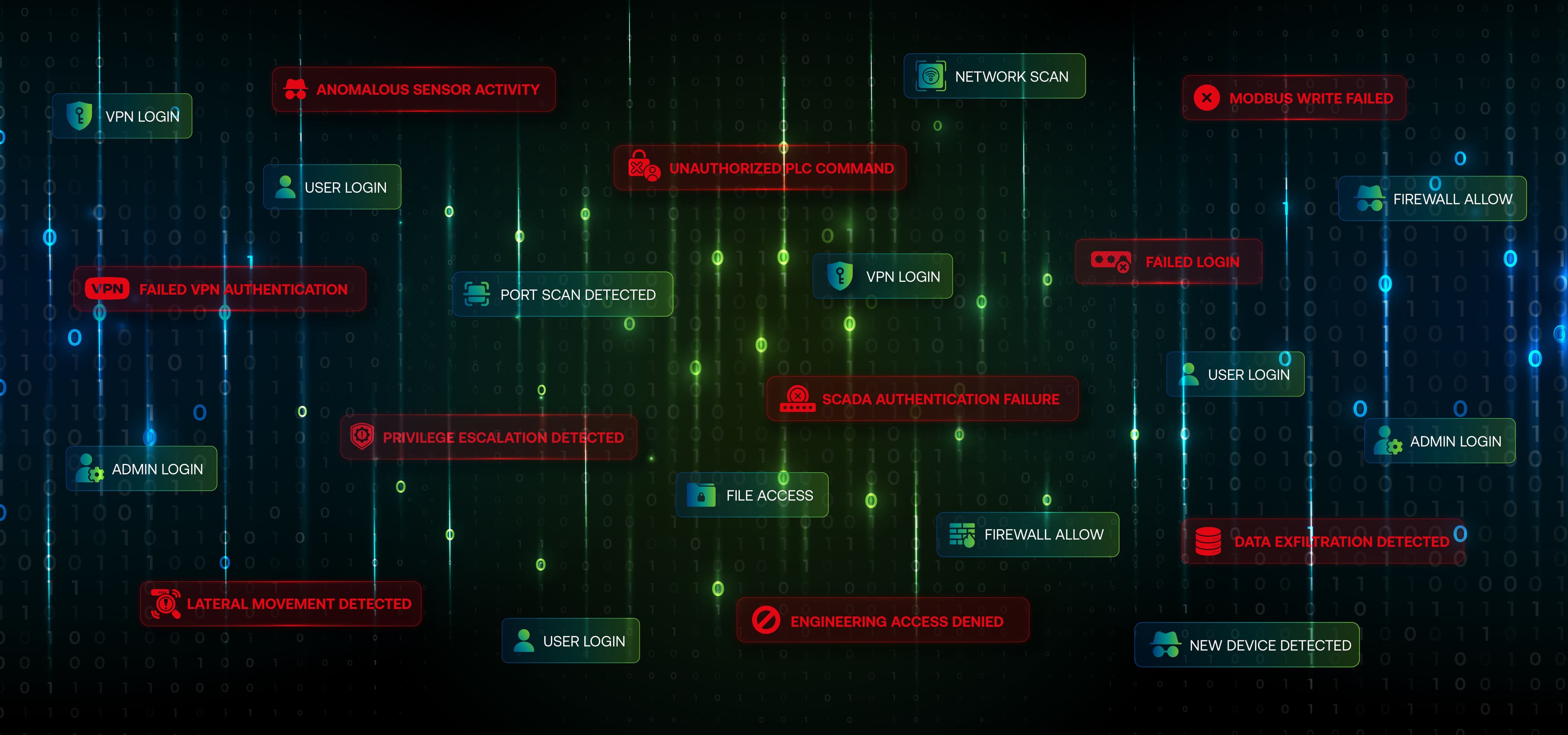
A few months ago, the telemetry pipeline of a mid-sized energy company came under review. Their OT environment, a mix of PLCs, SCADA systems, RTUs, and historian servers, was generating over 2 million log events per day. Their SOC team of four analysts was triaging it manually, shift after shift.
They weren't missing alerts because they lacked skill. They were missing them because no human team can sustainably process that volume, especially when 95% of it is benign polling cycles, heartbeat signals, and scheduled maintenance noise that looks identical to early-stage reconnaissance if you're not paying close enough attention.
That's the OT log problem in a nutshell. And it's only getting worse as IT/OT convergence deepens.
- 2–5M Events/day, typical OT site
- 72 hrs Avg. dwell time before OT detection
- <5% Alerts needing real human action
What Makes OT Telemetry Uniquely Hard
What makes OT telemetry uniquely hard isn't just the volume, it's the context. Protocols like Modbus, DNP3, and OPC-UA weren't designed with security logging in mind. A PLC polling a sensor every 250ms generates ~345,000 near-identical log entries per day. Without OT-specific domain knowledge, distinguishing that from a covert scan is genuinely difficult.
Add the fact that most security analysts are trained on IT threat models, and that a false-positive response in OT doesn't lock a workstation, it can halt a production line or trigger a safety shutdown, and you start to understand why traditional rule-based SIEM approaches struggle so badly here.
OT security teams are not struggling with a shortage of data. They're struggling with the ability to identify what matters before it becomes a problem.
Where AI-augmented Security Operations can make a real difference.
Not as a silver bullet, but as a force multiplier that gives analysts back the cognitive bandwidth they need to do genuinely expert work. Here's what that looks like in practice:
Behavioral baselining ML models learn the deterministic rhythms of each OT asset and surface deviations without pre-written rules. Anomalous register writes or unexpected peer communications become detectable at scale.
IT/OT cross-layer correlation AI links a phishing email, a VPN authentication, a lateral move to an engineering workstation, and an unusual SCADA command into a single, prioritized incident story.
Intelligent alert triage Instead of a raw alert queue, analysts see a ranked, context-rich list of incidents that genuinely warrant attention. Alert fatigue starts to retreat.
Natural language investigation "Show me all commands to PLC-07 in the 30 minutes before the pressure anomaly." This alone cuts investigation time dramatically and democratizes OT expertise across the team.
One important lesson for security teams: don't rush to automate. Spend 4–6 weeks building a proper behavioral baseline before trusting any model's anomaly detections. OT environments have production cycles, maintenance windows, and seasonal patterns that look like anomalies until the operational rhythm is fully understood. A premature AI deployment creates an alert storm worse than the original problem.
It's worth being direct about the analyst question, because this concern comes up often: AI in security operations is not about headcount reduction. Every OT security analyst is already stretched thin. The goal is to ensure their hours are spent on judgment calls, not on manually triaging log entries a well-calibrated model can assess in milliseconds.
In many successful AI-augmented security operations environments, analyst satisfaction improves. The work becomes more meaningful. Detection times drop. And the team finally has bandwidth for the threat hunting and proactive intelligence work that actually builds long-term resilience.
The convergence of IT and OT is not reversing. Every new connected sensor is both a telemetry source and a potential attack surface. The organizations that treat that log volume as a rich signal to be intelligently processed, rather than a noise problem to be endured, are the ones building genuinely defensible critical infrastructure.
The question isn't whether AI belongs in OT security operations. It's how quickly your team can get there safely.
Curious how context-aware investigations can help security teams cut through noise and accelerate decision-making? Request a Demo.
Additional Resources
- How Context-Aware Investigations Are Reshaping Modern Security Operations
- The Black Box AI Shrug - Part 1: Why Confidence Scores are Failing the Modern SOC
- The Black Box AI Shrug - Part 2: From Opaque Confidence Scores to Verifiable Evidence Chains
Frequently Asked Questions
OT environments rely on continuous communication between industrial systems, sensors, PLCs, RTUs, and SCADA platforms. These systems generate large volumes of telemetry to support operational visibility and reliability. As IT and OT environments become more connected, the volume of logs increases significantly, creating challenges for security teams trying to identify meaningful threats within the noise.
Organizations should first establish a clear understanding of normal operational behavior within their OT environment. Building accurate behavioral baselines, validating data quality, and ensuring human oversight are critical before relying on AI-driven detections. Rushing deployment without sufficient context can increase false positives and reduce analyst trust in the system.
AI can help OT security teams analyze large volumes of telemetry, establish behavioral baselines, correlate activity across IT and OT environments, and prioritize incidents based on context. This enables analysts to spend less time manually reviewing alerts and more time investigating threats that require human expertise.
About the author
Sasikumar Ganesan is a security architect, cryptographic systems engineer, and open-source technology leader with 20+ years of experience building privacy-preserving systems and national-scale digital infrastructure, including Aadhaar, MOSIP, and India's eSign framework. Authored Rahasya, an advanced open-source cryptography library, and recognized in Okta Ventures' Identity 25, he leads HarkX's vision for trust-first, agent-driven security operations.
Loved this insight?
Share it with your network and help secure the digital world.